Email Us
Phone
When a factory starts looking at conveyor automation, price is usually one of the first things discussed.
How much will the conveyor cost?
It is a fair question, but there is no standard figure that applies to every project. A conveyor moving lightweight cartons across a packing area has very different requirements from a heavy-duty system handling pallets or feeding multiple production machines. That is why a reliable quotation starts with the application, not just the length of the conveyor.
Several details can change the final price, sometimes quite significantly. The product itself is one of them. Its weight, dimensions, surface, shape and how it needs to be handled all influence the design.
Then there is the route the material needs to follow. A straight conveyor between two workstations is relatively straightforward. A system that has to turn corners, cross different levels, feed machines and connect several processes requires more engineering.
The quotation may take into account:
This explains why asking for the price of a “10-metre conveyor” alone rarely gives a useful answer. Two 10-metre conveyors can be built for completely different jobs.
The conveyor type has a direct bearing on both the design and the cost.
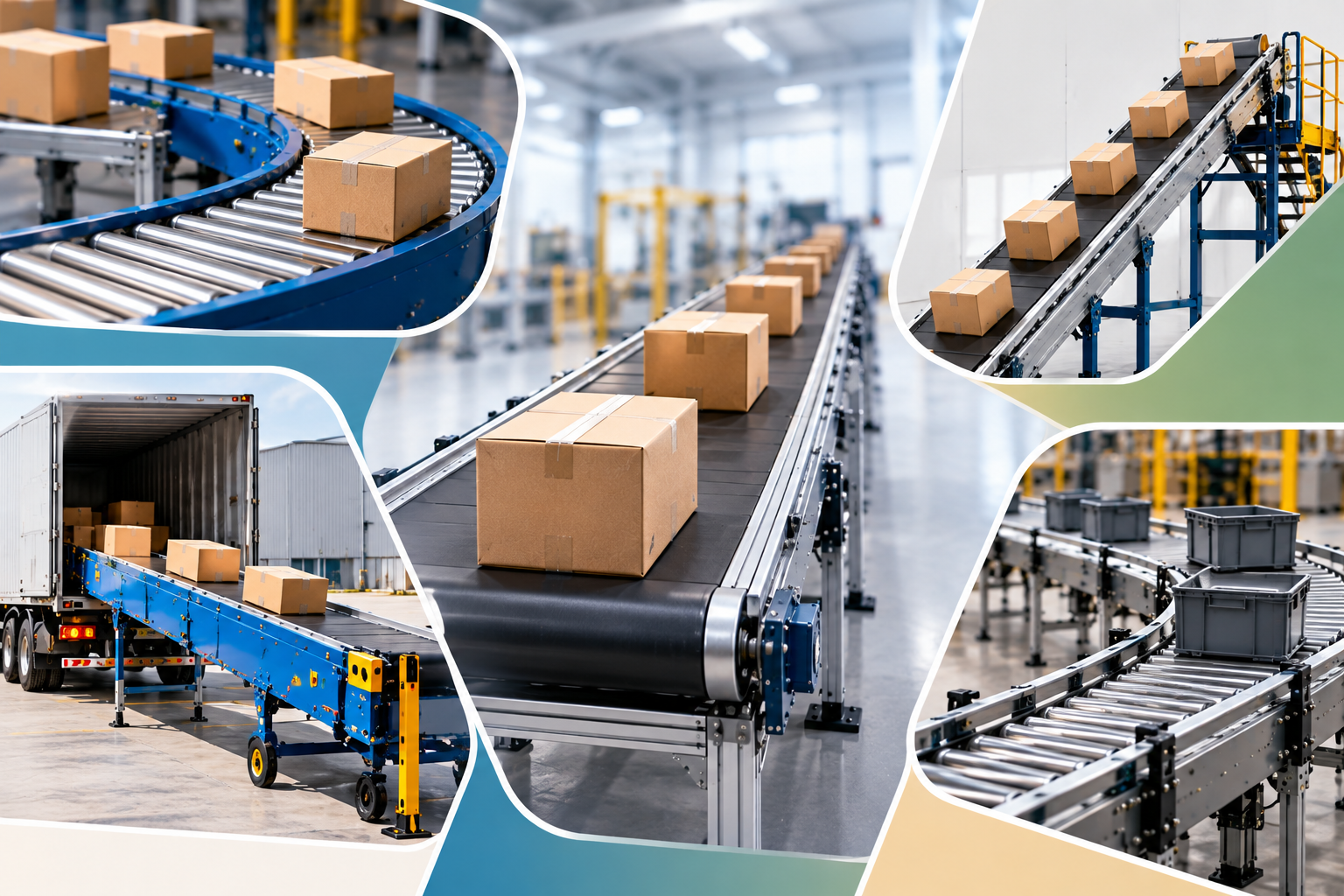
A belt conveyor system is often used for cartons, bags, components and packaged products. Where the speed needs to change with the production process, Variable Speed Belt Conveyors provide more control over the movement of material.
Roller conveyors are commonly used for boxes, totes and palletised loads. If products have to change direction, a bend section can be incorporated into the layout.
For movement between two floor levels, Inclined belt conveyor systems can be useful without taking up unnecessary space.
Loading operations are another area where the right design can make a noticeable difference. Truck Loading Conveyors help move goods between the warehouse and vehicle with less manual handling. Telescopic conveyors go a step further by extending towards the truck, making loading and unloading more convenient.
If you are comparing options from a Telescopic Conveyors Manufacturer India, look beyond the extension length. Load capacity, operating frequency, conveyor width, working environment and control requirements also matter.
Not every conveyor needs a sophisticated automation package.
A straightforward conveyor may operate with a motor, starter and basic controls. A high-volume production or warehouse application may need sensors, VFDs, PLC controls, automatic transfers, scanning or sorting.
The difference becomes clearer when you look at the actual workflow.
Suppose cartons arrive at one point in a warehouse and need to reach three different dispatch areas. A simple conveyor can move the cartons, but it cannot decide where each carton should go. A sorting arrangement and control logic may therefore be required.
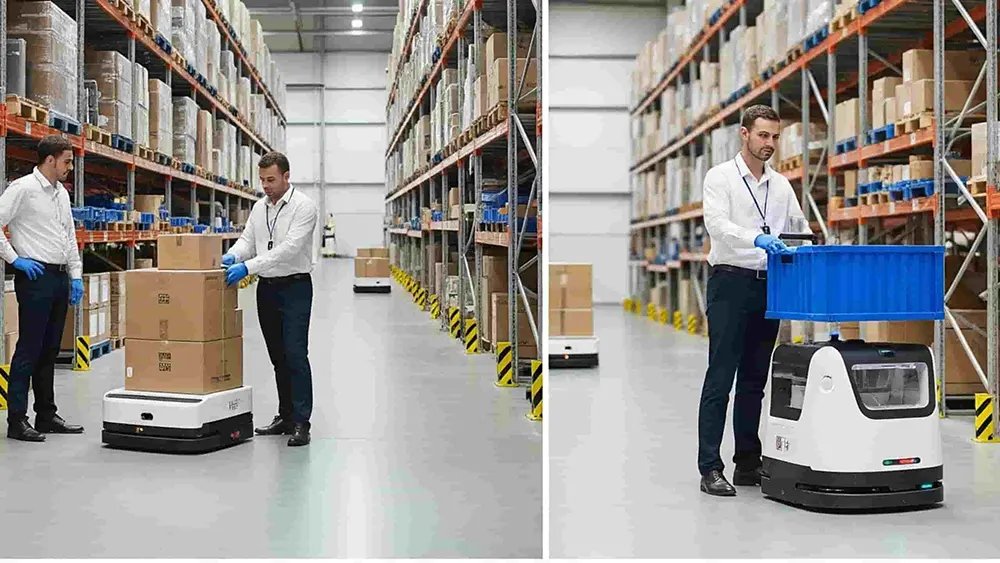
In larger facilities, conveyors can also work alongside AMRs and AGVs. A project may involve an Autonomous Mobile Robots manufacturer in India, an Automated Guided Vehicle system or an Automated Goods Vehicle manufacturer, depending on how materials need to move around the facility.
The sensible approach is to automate the part of the process that creates a genuine bottleneck. Adding technology for its own sake only increases the project cost.
Factories rarely have a completely empty floor waiting for new equipment.
There may already be machines, columns, walkways, doors, storage areas and operator stations in place. The new conveyor has to work around all of them while still maintaining a sensible material flow.
That is where custom engineering becomes important.
A conveyor may need an incline, a bend, a transfer section or a special support arrangement. Some applications also require Special Purpose Conveyors because the product or process does not suit a standard design.
This is one reason businesses often approach custom conveyor manufacturers rather than choosing a ready-made unit from a catalogue.
A site visit or layout review can reveal design requirements that are difficult to identify from a basic enquiry.
If you want a meaningful quotation from a conveyor system manufacturer, start by sharing the details of the job.
You should ideally provide:
Photos, a plant layout or even a short video of the current material movement can make the discussion much easier.
With this information, an engineering team can recommend the appropriate conveyor rather than simply attaching a price to a standard machine.
Two quotations may appear similar until you look at what is actually included.
One supplier may quote a basic conveyor, while another may include better controls, stronger construction, safety equipment, installation and commissioning. The difference may not be obvious from the first page of the quotation.
Before comparing suppliers, check:
This becomes particularly important when evaluating conveyor system manufacturers in India for a larger project.
The cheapest quotation may reduce the initial purchase cost, but the more useful comparison is whether the proposed system will perform reliably under your actual operating conditions.
Some material handling jobs need more than a conventional belt or roller conveyor.
For example, facilities dealing with unusual products, controlled environments, difficult routes or specific production processes may need a specially engineered solution.
Depending on the application, this can include:
Likewise, projects requiring fixed-route automated movement may incorporate a rail guided vehicles conveyor system, while larger warehouse automation projects can connect conveyors with autonomous transport systems.
These systems should be selected according to the process rather than the popularity of a particular technology.
The purchase price is only one part of the calculation.
Consider what the system is expected to improve. If operators currently spend several hours every day carrying products between two points, the conveyor may reduce that repetitive work. If forklifts are constantly travelling between production and dispatch, a fixed conveying route may reduce some of that movement.
There can also be less waiting between processes and fewer unnecessary product transfers.
So when comparing the cost of a conveyor, it is worth looking at the total operating benefit, not just the amount written at the bottom of the quotation.
A well-designed system should make sense both technically and financially.
The supplier you choose can have as much influence on the final result as the conveyor itself.
Look for a manufacturer that can understand your application, develop the layout, manufacture the equipment and support installation. This is particularly relevant for factories that need customised or integrated solutions rather than an off-the-shelf conveyor.
For businesses searching for an Industrial conveyor systems manufacturer in India, experience with different conveyor types and industrial applications is worth considering alongside manufacturing capability, engineering support and after-sales service.
Dynamic Industrial provides conveyor and material handling solutions for industrial applications, including customised systems designed around specific production and warehouse requirements.
There is no fixed price for a conveyor system. The final cost depends on its type, dimensions, load capacity, speed, construction, drive system, controls, automation and installation requirements.
It depends on the material and the process. Belt conveyors are widely used for general product movement, while roller conveyors can work well for cartons, containers and pallets. Inclined, chain, telescopic and specialised conveyor systems are used when the application calls for them.
Usually, yes. Sensors, VFDs, PLCs, sorting equipment and integration add to the initial project cost. Whether that extra investment makes sense depends on the amount of manual handling, required throughput and operational improvements expected from the automation.
Share the product dimensions and weight, required throughput, conveyor length, movement direction, height, available space and operating conditions. A layout, photograph or video of the existing process can also help the manufacturer understand the requirement.
Look at the manufacturer's engineering experience, customisation capability, manufacturing facilities, installation support and after-sales service. A good supplier should be able to recommend a system based on your application rather than simply offering a standard conveyor.