Email Us
Phone
Your factory may be running efficiently. Production targets are being achieved, machines are operating continuously, and orders are being delivered on time.
But there is one hidden area where many manufacturers continue losing money every day — material movement.
How much time does your team spend moving raw materials between production stages? How often do forklifts travel across the facility for repetitive tasks? How many employees are involved in carrying, loading, unloading, and transferring products?
These activities may look like a normal part of manufacturing operations. However, when calculated over months and years, manual material handling can significantly increase operational costs through labour expenses, production delays, product damage, and inefficient workflow.
This is where industrial conveyor systems can make a major difference. A well-designed conveyor solution does not simply move products from one place to another. It creates a smoother material flow, reduces unnecessary handling, improves productivity, and helps manufacturers build a more organised production environment.
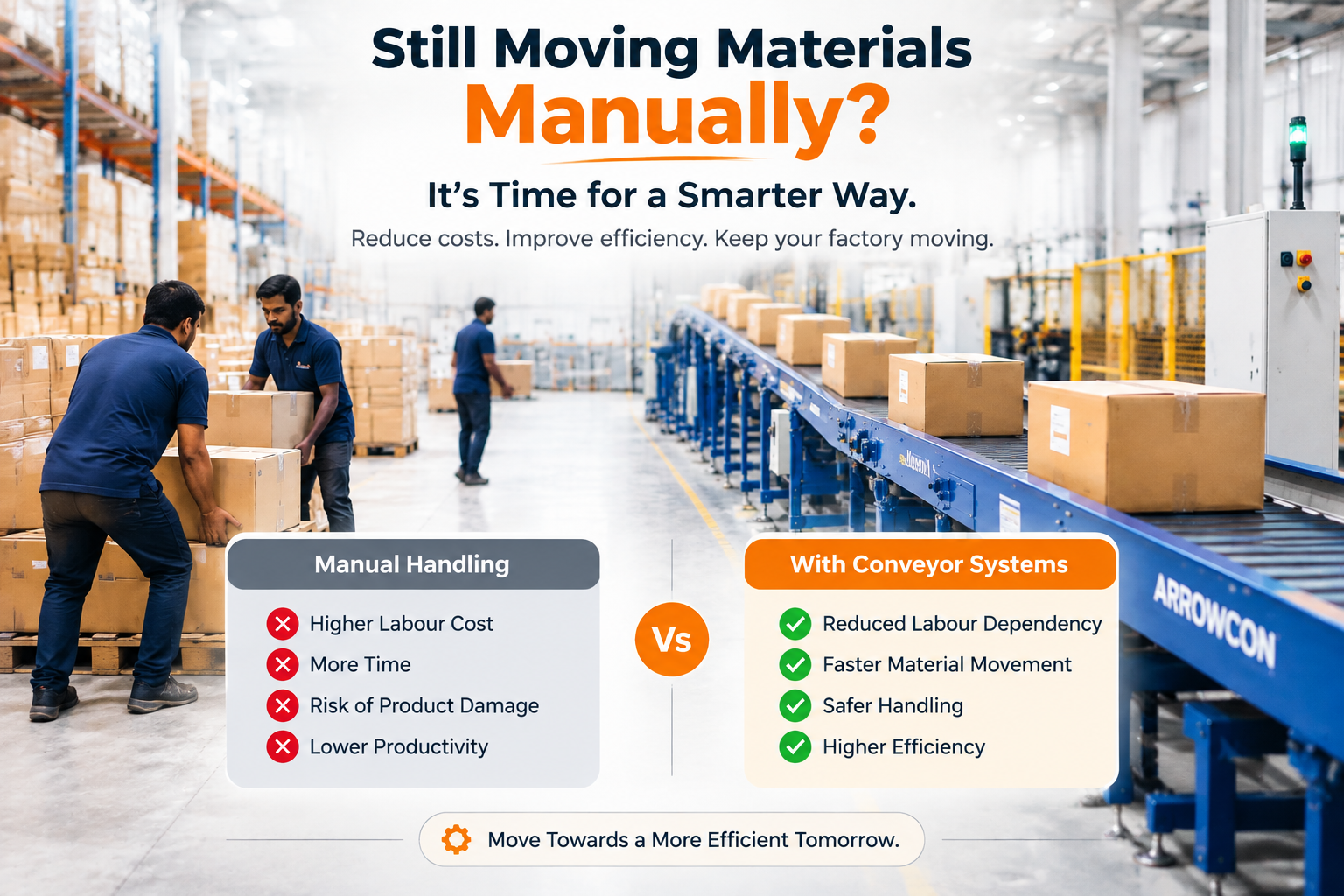
Many factories depend on workers, trolleys, and forklifts for internal transportation. While this approach may work for smaller operations, it becomes challenging as production volume increases.
A typical manufacturing process may involve multiple movement stages:
Every transfer requires time, manpower, and coordination.
When these movements are handled manually, manufacturers often experience:
The problem is not always the production capacity of your machines.
Sometimes, the real bottleneck is the way materials move between those machines.
This is why many industries are shifting towards automated material handling solutions and customised conveyor systems.
Modern factories require consistent and predictable material flow. This is where industrial conveyor systems provide a practical solution.
Unlike manual transportation, conveyors create a fixed movement path that allows materials to travel continuously between different operational points.
Whether it is a manufacturing plant, warehouse, packaging unit, automotive facility, or logistics centre, the right conveyor system can improve efficiency by reducing unnecessary movement.
Material transportation is repetitive work. Employees spending hours carrying products, pushing carts, or transferring components between stations are performing tasks that can often be automated.
A conveyor system allows businesses to automate repetitive movement and use their workforce for more valuable activities such as quality inspection, machine operation, maintenance, and process improvement. This does not mean replacing people. It means allowing employees to focus on tasks where human skills create greater value.
In manufacturing, even small delays can impact the entire production cycle. If a workstation is waiting for components or raw materials, the entire process can slow down. A properly designed conveyor system ensures that materials reach the required location at the right time.
By improving material flow, conveyors help reduce idle time and production interruptions.
Forklifts play an important role in industries, especially for heavy loads and pallet transportation. However, using forklifts for every internal movement can increase operational expenses.
Common forklift-related costs include:
For repetitive movement between fixed locations, conveyors can provide a more efficient alternative.
For example, truck loading conveyors can simplify loading and unloading operations by reducing manual movement around dispatch areas. The objective is not to remove forklifts completely. It is to use forklifts where they create the highest value while allowing conveyors to handle repetitive transportation.
Every additional manual transfer creates another opportunity for products to get damaged.
Repeated lifting, shifting, and placing can result in:
A properly designed conveyor system provides controlled movement and reduces unnecessary handling. However, selecting the correct conveyor is important. A conveyor designed for heavy industrial components may not be suitable for fragile products. Similarly, food, pharmaceutical, automotive, and packaging industries may require different conveyor designs. This is why choosing experienced conveyor manufacturers in India becomes important. The right solution is not just about installing equipment. It is about designing a material movement system according to the application.